
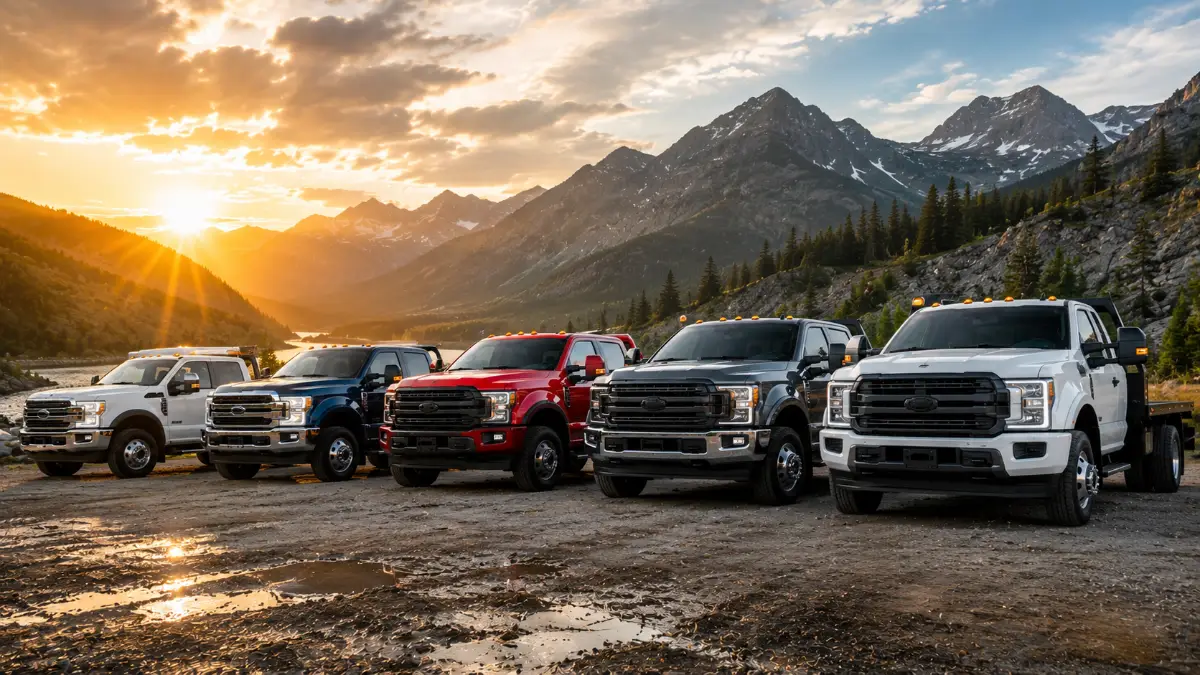
Searching for trucks for sale in 2026 can mean very different things. Some buyers want an affordable pickup for commuting and light hauling. Others need a truck for towing, construction, farming or commercial work.
The best way to shop is to start with your actual needs, then compare truck size, price, condition, financing and ownership costs. This guide explains what to look for in new and used trucks for sale and how to avoid choosing a truck that looks affordable but costs more than expected.
What Are the Best Trucks for Sale for Different Buyers?
There is no single best truck for every buyer.
For shoppers focused on a lower new-vehicle price, compact pickups are worth considering. The 2026 Ford Maverick currently starts at $28,145 MSRP, while the Hyundai Santa Cruz starts at $29,750. For buyers who want a midsize pickup, the 2026 Toyota Tacoma starts at $32,445, and the Ford Ranger starts at $33,550.
Full-size buyers can look at models such as the Ford F-150, Chevrolet Silverado 1500 and Ram 1500. Ford currently lists the 2026 F-150 from $39,585. The important point is that starting MSRP does not tell you which truck is the best value. Engine, cab, drivetrain, equipment, towing needs and ownership costs can change the calculation considerably.
New Trucks for Sale in 2026
New trucks are attractive if you want factory warranty coverage, the latest features and the ability to select a particular configuration.
Some current 2026 starting prices include:
Also Read: Hertz Car Sales Review: What You’re Really Getting When You Buy an Ex-Rental
| Truck | Starting MSRP |
| Ford Maverick | $28,145 |
| Hyundai Santa Cruz | $29,750 |
| Toyota Tacoma | $32,445 |
| Ford Ranger | $33,550 |
| Ford F-150 | $39,585 |
Ford’s current showroom confirms the Maverick, Ranger and F-150 pricing. Toyota lists the Tacoma from $32,445, while Hyundai lists the Santa Cruz from $29,750. These are starting MSRPs, not necessarily the final amount you will pay.
Your final price can include:
- Destination or freight charges
- Taxes
- Registration
- Dealer fees
- Optional equipment
- Financing costs
- Accessories
A base model can therefore become considerably more expensive after you add four-wheel drive, a larger engine, a premium trim or towing equipment.
Used Trucks for Sale: What Should You Look For?
Used trucks can provide better value than buying new, but condition matters more than the model year alone.
When comparing used trucks, check:
- Mileage
- Accident history
- Title status
- Number of owners
- Maintenance records
- Tire condition
- Brake condition
- Rust
- Engine condition
- Transmission condition
- Suspension
- Previous towing or commercial use
A high-mileage truck with detailed maintenance records can be a better purchase than a lower-mileage truck with an unclear history.
Which trucks hold their value best?
Resale value varies significantly by model. Current iSeeCars data ranks the Toyota Tacoma first among midsize trucks, with an estimated 80.1% five-year resale value. The Ford Ranger ranks second at 70%. Among small trucks, the Ford Maverick has a 68.4% five-year resale value. Among full-size trucks, the Toyota Tundra leads the current iSeeCars ranking at 78.6%. These figures are estimates based on iSeeCars’ methodology, so they should be used for comparison rather than treated as a guaranteed future selling price.
Where Can You Find Trucks for Sale?
Once you’ve decided what type of truck you need, search several sources rather than relying on one listing.
Useful places include:
- Manufacturer inventory pages
- Local dealerships
- Online vehicle marketplaces
- Certified used-vehicle programs
- Private-party listings
- Commercial truck dealers
- Fleet and auction sources for specialized vehicles
When searching online, use filters for:
- Price
- Model year
- Mileage
- Make
- Model
- Location
- New or used condition
- Drivetrain
- Cab configuration
- Bed length
- Engine
- Towing capability
Do not compare trucks only by the headline price. A $32,000 truck with 20,000 miles and a $29,000 truck with 100,000 miles are not directly comparable. Equipment, condition, history and mileage all affect value.
How to Choose the Right Truck Size
Compact trucks
Compact pickups are generally better suited to buyers who want a smaller vehicle for commuting, light hauling and occasional towing. The Ford Maverick is an example of this category.
Midsize trucks
Midsize trucks such as the Tacoma and Ranger offer a middle ground between compact pickups and full-size trucks. They can make sense for buyers who need more capability but do not want the size of a full-size pickup.
Full-size trucks
Full-size pickups are better suited to buyers who regularly need greater towing, payload or passenger capacity. Models such as the F-150 and Silverado 1500 compete in this segment.
Heavy-duty trucks
Heavy-duty pickups are designed for substantially greater towing and payload demands. If you regularly tow a heavy trailer or operate a work truck, compare the exact engine, axle, cab and drivetrain configuration rather than relying on the model’s maximum advertised towing number.
What Should You Check Before Buying a Used Truck?
A used truck should receive more than a quick test drive.
Check the vehicle history
Look for:
- Reported accidents
- Title problems
- Mileage discrepancies
- Previous owners
- Service records
- Commercial or fleet use
A vehicle-history report is useful, but it does not replace an independent inspection.
Inspect the exterior
Look for:
- Uneven body-panel gaps
- Mismatched paint
- Rust
- Signs of collision repair
- Cracked lights
- Damaged glass
- Uneven tire wear
Inspect the mechanical condition
During the inspection and test drive, pay attention to:
- Engine warning lights
- Fluid leaks
- Unusual engine noise
- Excessive smoke
- Transmission hesitation
- Hard shifting
- Steering problems
- Brake vibration
- Suspension noises
- Four-wheel-drive operation
Get an independent inspection
For an expensive used truck, an independent mechanic can identify problems that are difficult to detect during a normal test drive.
This is especially useful when buying an older, high-mileage, diesel or heavily worked truck.
What Financing Should You Consider?
If you are financing a truck, get loan offers before committing to the purchase. A pre-approved loan can help you understand your actual budget and gives you another offer to compare with dealer financing.
Your interest rate can depend on:
- Credit history
- Loan term
- Vehicle age
- Vehicle type
- Down payment
- Lender
- Loan amount
- Income and other underwriting factors
Do not assume a particular credit score automatically guarantees a particular APR. Current U.S. auto-loan conditions remain relatively expensive. Reuters reported that U.S. consumers originated a record $211 billion in auto loans during Q2 2026, while current mid-2026 reporting continues to show elevated borrowing costs.
Compare total loan cost, not just the payment
A longer loan can reduce the monthly payment while increasing the amount of interest paid.
Before signing, compare:
- APR
- Loan term
- Monthly payment
- Amount financed
- Total interest
- Total amount paid
Dealer vs. Private Seller: Which Is Better?
Buying from a dealer
Dealers may provide:
- Financing
- Trade-in options
- Larger inventories
- Warranty programs on some used vehicles
- Certified pre-owned vehicles
The advertised price should still be compared with other listings.
Buying from a private seller
Private-party purchases can sometimes offer competitive prices, but the buyer generally has to handle more of the process.
Before paying a private seller:
- Verify the seller’s identity.
- Check the VIN.
- Confirm title ownership.
- Check for liens.
- Review the vehicle history.
- Arrange an independent inspection.
- Confirm the payment and title-transfer process.
Never send money simply because a seller claims another buyer is waiting.
How Much Should You Pay for a Truck?
Start with comparable listings.
For a used truck, compare vehicles with similar:
- Model year
- Mileage
- Trim
- Engine
- Drivetrain
- Cab
- Bed
- Equipment
- Condition
Then adjust for documented differences. For a new truck, ask the dealer for an out-the-door price rather than negotiating only around monthly payments. The out-the-door figure should make it easier to understand what you are actually paying after applicable taxes and fees.
Read More: Detroit Axle: Kit Do You Actually Need?
What About Towing and Payload?
If towing is one of your main reasons for buying a truck, this should be one of the first specifications you check. Do not rely on a model’s maximum towing figure without checking the exact configuration.
Towing and payload capability can vary based on:
- Engine
- Transmission
- Cab
- Bed
- Drivetrain
- Axle ratio
- Tow package
- Vehicle configuration
Also remember that passengers, cargo and trailer tongue weight affect available payload. The right truck is the one that comfortably meets your actual requirements, not necessarily the one with the largest number in an advertisement.
Should You Buy an Electric Truck?
Electric trucks can make sense for buyers who have convenient charging and predictable driving patterns.
Before buying one, compare:
- Purchase price
- Financing
- Charging costs
- Electricity rates
- Insurance
- Tire costs
- Maintenance
- Expected resale value
Do not assume that an electric truck automatically costs less to own. Also be careful with outdated articles about federal electric-vehicle tax incentives. The Internal Revenue Service states that the New Clean Vehicle Credit, Previously-Owned Clean Vehicle Credit and Qualified Commercial Clean Vehicle Credit are not available for vehicles acquired after September 30, 2025. State and local incentives may have different rules, so verify current eligibility with the relevant government authority before including an incentive in your budget.
What About Commercial Trucks for Sale?
Commercial trucks require a different buying process from a personal pickup.
Business buyers should consider:
- Expected annual mileage
- Payload
- Towing requirements
- Fuel or charging costs
- Maintenance
- Downtime
- Insurance
- Financing
- Service availability
- Intended business use
For Class 8 and other heavy commercial trucks, prices vary substantially according to age, mileage, configuration, engine, sleeper setup, equipment and market conditions. Because commercial-truck pricing can change quickly, avoid relying on a single generic market figure when evaluating a specific vehicle.
How to Get a Better Deal on Trucks for Sale
The cheapest listing is not automatically the best deal. A better approach is to compare the total value of each truck.
Look for:
Lower mileage: When condition and history are comparable, lower mileage can support a higher asking price.
Better maintenance records: Detailed service documentation reduces uncertainty.
Better equipment: A truck with the towing or technology package you actually need may be worth more.
Clean history: Accident-free history and clear title documentation can make a truck easier to evaluate.
Lower ownership cost: Fuel economy, insurance, maintenance and expected depreciation all matter.
If a truck needs tires, brakes or other repairs, those costs can become part of your negotiation.
Final Checklist Before Buying a Truck
Before completing the purchase, confirm that you have:
- Defined how much towing and payload capacity you need
- Set a total purchase budget
- Compared new and used trucks
- Compared multiple listings
- Checked financing offers
- Verified the VIN and title
- Reviewed the vehicle history
- Checked maintenance records
- Test-driven the truck
- Arranged an independent inspection when appropriate
- Confirmed towing and payload ratings
- Compared the final purchase price
- Read the complete contract before signing
Frequently Asked Questions
What is the cheapest new truck for sale in 2026?
The 2026 Ford Maverick currently starts at $28,145 MSRP in the U.S. Ford’s current showroom also lists the Ranger from $33,550 and F-150 from $39,585.
What are the best trucks for sale right now?
There is no single best choice. The Maverick is attractive for buyers prioritizing a lower starting price, while the Tacoma and Ranger offer midsize alternatives and the F-150 serves buyers who need a full-size pickup.
Should I buy a new or used truck?
Buy new if warranty coverage, current technology and a specific factory configuration are priorities. Buy used if getting more equipment for your budget matters more and you are willing to inspect the vehicle carefully.
How many miles is too many for a used truck?
There is no universal mileage cutoff. Maintenance history, previous use, engine condition and overall mechanical condition can matter more than the odometer alone.
How do I know if a truck for sale is fairly priced?
Compare it with similar trucks using model year, mileage, trim, engine, drivetrain, equipment and condition. Comparing only the model name is not enough.
Should I get pre-approved for a truck loan?
Pre-approval can be useful because it establishes a financing benchmark before you negotiate with a dealer. It can also help you determine how much a truck fits your budget.
Is buying a truck from a private seller safe?
It can be, but the buyer needs to perform more due diligence. Verify the title, VIN, liens, vehicle history and mechanical condition before transferring money.
What should I inspect on a used truck?
Check the title, VIN, accident history, maintenance records, engine, transmission, brakes, tires, suspension, frame and underbody. An independent inspection can provide another layer of protection.
Is a Tacoma worth more than other used midsize trucks?
Its resale value can be stronger. I see Cars currently estimates the Tacoma at 80.1% five-year resale value, compared with 70% for the Ford Ranger.
Should I buy a truck with four-wheel drive?
Four-wheel drive is useful for certain off-road, weather and work conditions. If you rarely need it, a two-wheel-drive truck may provide better value.
What does MSRP mean when buying a truck?
Manufacturer’s suggested retail price (MSRP) is the manufacturer’s advertised price before applicable taxes, fees and other costs. It is not necessarily the final amount you will pay.
What should I check before buying a truck for towing?
Check the towing and payload ratings for the exact truck configuration. Engine, cab, drivetrain, axle ratio and tow equipment can all affect the vehicle’s actual capability.
Are electric trucks worth buying in 2026?
They can be a good fit for drivers with convenient charging and predictable daily use. Compare purchase price, charging, insurance, maintenance and resale value before deciding.
Are federal EV tax credits still available for trucks bought in 2026?
The federal New Clean Vehicle, Previously-Owned Clean Vehicle and Qualified Commercial Clean Vehicle credits are not available for vehicles acquired after September 30, 2025.
What is the most important factor when buying a used truck?
Condition and history should be among your highest priorities. A low asking price does not make a truck a good deal if it has major mechanical problems or an unclear title history.
