
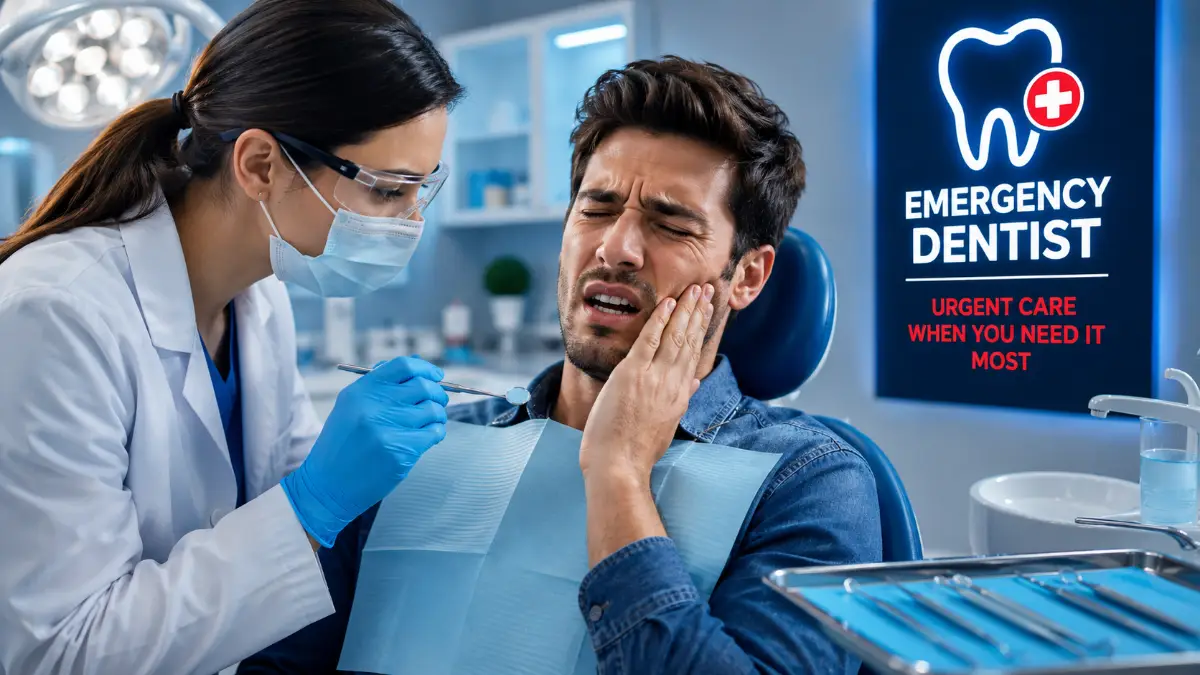
Emergency dentist: Choose an emergency dentist for severe tooth pain, a knocked-out permanent tooth, a painful broken tooth, localized swelling, a suspected dental abscess, or a lost restoration causing pain. Hospital ER: Go to the emergency room immediately for trouble breathing or swallowing, uncontrolled bleeding, major facial trauma, a suspected jaw fracture, or rapidly spreading swelling.
Dental emergencies can begin suddenly. A toothache may become unbearable overnight, a crown can break during a meal, a child may take a fall during sport, or swelling can develop rapidly around a painful tooth. The right action is to decide whether you need a same-day emergency dentist or immediate hospital care, then call the appropriate provider without delay.
Emergency Dentist Decision Guide
| Symptom or situation | Usual urgency | Best first contact |
| Knocked-out permanent tooth | Immediate | Emergency dentist |
| Severe, persistent toothache | Same day | Emergency dentist |
| Facial or gum swelling without airway symptoms | Same day | Emergency dentist |
| Broken tooth causing pain or sharp edges | Same day | Emergency dentist |
| Lost crown or filling causing pain | Urgent | Emergency dentist |
| Small, painless tooth chip | Routine | General dentist |
| Difficulty breathing or swallowing | Immediate | Hospital emergency department |
| Bleeding that does not stop with direct pressure | Immediate | Hospital emergency department |
| Major facial trauma or suspected fractured jaw | Immediate | Hospital emergency department |
| Rapidly spreading facial, mouth, or neck swelling | Immediate | Hospital emergency department |
Call an emergency dentist today for urgent tooth pain, dental trauma, localized swelling, or a damaged restoration. Go to the ER immediately if symptoms affect breathing or swallowing, bleeding cannot be controlled, or facial trauma is severe.
What Counts as Emergency Dental Care?
Emergency dental care is needed when waiting could worsen pain, infection, bleeding, trauma, or damage to a tooth and surrounding tissues.
Same-day dental care may be appropriate for:
- Severe, sharp, throbbing, or worsening tooth pain
- A permanent tooth that has been knocked out, loosened, displaced, or fractured
- A broken tooth exposing sensitive inner tissue
- A gum boil, pus, drainage, foul taste, or suspected dental abscess
- Localized gum or facial swelling
- A lost crown, bridge, veneer, or filling causing pain
- A mouth injury after a fall, impact, sports accident, or collision
- Bleeding that has stopped but followed a significant injury
- A sharp tooth edge cutting the tongue, cheek, or lip
- Pain severe enough to disrupt sleep, eating, or daily activities
A small painless chip, stable mild sensitivity, or a lost filling without pain may be less urgent. Still, contact a dentist promptly so the issue does not become more serious.
Also Read: Smith Machine Mistakes, Fixes, and Smarter Training Strategies
When a Toothache Needs Same-Day Attention
A severe toothache can result from decay, a cracked tooth, inflammation inside the tooth, a damaged filling, gum disease, infection, or trauma. Symptoms alone cannot identify the cause, so an examination may be needed.
Contact an emergency dentist if pain:
- Is constant, sharp, throbbing, or escalating
- Prevents normal sleep or eating
- Hurts when biting or releasing the bite
- Happens with swelling, fever, pus, drainage, or bad taste
- Begins after an accident or impact
- Occurs with a loose, cracked, or visibly damaged tooth
- Does not improve with sensible short-term comfort measures
Treatment may involve a filling, temporary restoration, crown, root canal treatment, drainage, tooth splinting, extraction, or follow-up care. The right approach depends on the clinical examination and, where needed, dental imaging.
What to Do if a Permanent Tooth Is Knocked Out
A knocked-out permanent tooth needs immediate professional attention. Proper handling can help protect the tooth while you arrange emergency care.
First Aid Steps
- Find the tooth.
- Hold it only by the crown, the white part normally visible above the gumline.
- Do not touch the root.
- If it is dirty, rinse it gently and briefly with clean water or milk.
- Do not scrub it, dry it, or wrap it in tissue.
- If you can safely do so, gently place it back in the socket in the correct position.
- Bite softly on clean gauze to help hold it in place.
- If reinsertion is not possible, keep the tooth moist in cold milk or saliva.
- Contact an emergency dentist immediately.
Do not store a knocked-out tooth in a dry container, hot water, alcohol, disinfectant, or mouthwash. Mayo Clinic guidance advises handling the tooth by the crown, protecting the root, keeping it moist, and obtaining prompt dental treatment.
If a Baby Tooth Is Knocked Out
Do not put a knocked-out baby tooth back into the socket. Reinserting a primary tooth can harm the permanent tooth that is developing beneath it.
Use clean gauze to control bleeding, apply a cold compress to the outside of the face, and contact a dentist or pediatric dentist. The child may need an assessment of the gums, nearby teeth, and the permanent tooth developing underneath.
Broken Teeth, Lost Crowns, and Filling Problems
A visible chip can be minor, but a crack can extend deep into the tooth. It is not always possible to tell how serious an injury is by looking at it.
While waiting for emergency dental care:
- Rinse the mouth gently with warm water
- Save any broken tooth pieces
- Keep fragments moist in milk or saliva if possible
- Apply a cold compress outside the cheek for swelling
- Avoid chewing on the affected side
- Cover sharp edges with dental wax or sugar-free gum temporarily
- Avoid hard, sticky, very hot, very cold, or sugary foods
If a crown falls off, save it and take it to the appointment. Do not use household glue to reattach it. A dentist can determine whether it can be recommended or whether the underlying tooth requires additional treatment.
Read More: Tubby Todd Review: Is It Worth It for Baby Skin Care?
Dental Abscesses and Facial Swelling
A dental abscess is an infection around a tooth or within the gums. Possible signs include throbbing pain, pressure, facial swelling, gum swelling, fever, drainage, a pimple-like bump on the gum, or a foul taste. A dental abscess needs professional evaluation. Do not cut, squeeze, puncture, or attempt to drain a swollen area yourself. Pain may reduce temporarily even when the underlying infection remains.
Contact an emergency dentist the same day for a suspected abscess, localized swelling, fever, drainage, or severe tooth pain. Go to the ER if swelling spreads toward the eye, tongue, throat, mouth floor, or neck, or if it affects breathing, swallowing, speaking, or mouth opening. The NHS states that a dental abscess needs urgent treatment and will not resolve on its own.
Pain Relief and Antibiotic Safety
Short-term home measures may reduce discomfort while you arrange care. They do not treat the source of an infection, cracked tooth, deep cavity, or damaged restoration.
Short-Term Comfort Measures
- Rinse gently with warm salt water
- Apply a cold compress to the outside of the face
- Choose soft foods and chew on the unaffected side
- Avoid very hot, cold, acidic, or sugary foods and drinks
- Keep your head elevated if pain throbs or swelling worsens when lying down
- Use over-the-counter pain medicine only as directed on its label and only if appropriate for you
Medication Precautions
Ibuprofen and other NSAIDs may not be suitable for everyone. Ask a pharmacist, dentist, or physician before taking them if you have kidney disease, a history of stomach ulcers or gastrointestinal bleeding, an NSAID allergy, a bleeding disorder, some heart conditions, medication interactions, or pregnancy-related restrictions.
Acetaminophen, also called paracetamol, has different safety limits. It may not be appropriate for people with liver disease or those already using another medication that contains acetaminophen.
Do Not Self-Prescribe Antibiotics
Do not take leftover, borrowed, expired, or unprescribed antibiotics for tooth pain. Antibiotics do not repair a cracked tooth, remove decay, replace a filling, or eliminate every infection source without dental treatment.
For many urgent dental pain and localized swelling problems, clinical guidance prioritizes treating the dental cause rather than relying on antibiotics alone. A dentist or physician should decide whether antibiotics are appropriate after assessing your symptoms and health history.
How to Find an Emergency Dentist Near Me
When you search for “emergency dentist near me,” choose a clinic based on current availability and the services it offers, not solely on search rankings or advertising claims.
Before You Travel
- Search Google Maps and local listings for emergency dental clinics nearby.
- Check the exact address, route, current phone number, and opening hours.
- Confirm the clinic treats dental emergencies rather than only routine care.
- Call before travelling and briefly describe your symptoms.
- Ask whether a same-day dentist is available.
- Confirm evening, weekend, holiday, and after-hours availability.
- Ask whether walk-ins are accepted or an appointment is required.
- Confirm whether the clinic treats children when needed.
- Ask whether your insurance is accepted and what self-pay options are available.
- Request an estimated emergency examination fee.
- Ask whether X-rays and treatment are billed separately.
- Confirm what you should bring, including identification, insurance details, a medication list, broken tooth fragments, or a knocked-out tooth.
Some providers use “24 hour emergency dentist” to describe an answering service, on-call system, or limited after-hours coverage. Call first to confirm that a dentist can see you before travelling.
How Soon Can an Emergency Dentist See You?
Timing depends on location, opening hours, clinic staffing, appointment demand, and the seriousness of the dental issue. Some general dental practices reserve same-day appointments for urgent cases, while dedicated emergency clinics may offer evening, weekend, or holiday availability.
When calling, give the key symptom first. For example: “I have a knocked-out permanent tooth,” “My face is swelling,” “I have severe pain and fever,” or “I broke a tooth and cannot bite.” This helps the dental team direct you safely.
If a clinic cannot see you promptly and symptoms are getting worse, contact another emergency dental provider. Seek medical emergency care if symptoms escalate to breathing or swallowing difficulty, uncontrolled bleeding, serious trauma, or rapidly spreading swelling.
What Happens During an Emergency Dental Appointment?
Emergency dental care focuses on diagnosis, pain control, infection or trauma management, and protecting the affected tooth. Some treatment may be completed during the initial visit, while other treatment may be planned for a later appointment.
Your visit may include:
- A review of symptoms, medical history, medications, allergies, and injury details
- Oral examination
- Dental X-rays when clinically needed
- Local anesthetic or other appropriate pain-control measures
- A temporary filling, restoration, or protective dressing
- Assessment of a crown or filling
- Tooth splinting after trauma
- Drainage where clinically appropriate
- Root canal treatment, extraction, or referral where needed
- A clear follow-up plan
Ask the dentist to explain the diagnosis, treatment options, expected benefits, limitations, costs, and follow-up needs before treatment begins.
What Does an Emergency Dentist Cost?
Emergency dental costs differ based on location, clinic, time of appointment, insurance benefits, imaging needs, and treatment complexity. A consultation generally costs less than procedures such as a root canal, extraction, abscess drainage, crown repair, or trauma treatment.
Potential charges can include:
- Emergency examination
- Dental X-rays
- Temporary filling or protective restoration
- Crown repair or replacement
- Root canal treatment
- Tooth extraction
- Abscess drainage
- Tooth splinting
- Prescription medication where clinically appropriate
- Follow-up restorative treatment
Ask the clinic about its emergency examination fee before you travel. After the dentist examines you, request a clear explanation of recommended treatment, costs, alternatives, and payment arrangements.
If you do not have insurance, ask about self-pay rates, financing, payment plans, dental-school clinics, or community dental services.
Reducing Your Risk of a Future Dental Emergency
Regular dental care cannot prevent every injury, but it can reduce avoidable pain and damage.
- Wear a properly fitted mouthguard for contact sports and activities with fall risk
- Avoid chewing ice, hard candy, unpopped kernels, pens, or packaging
- Never use teeth as tools
- Have damaged fillings, loose crowns, recurring tooth pain, and cracked teeth assessed early
- Attend routine dental checkups
- Brush twice daily using fluoride toothpaste
- Clean between teeth every day
- Seek dental advice for persistent sensitivity, gum bleeding, swelling, or bite changes
Treating a small problem early is often simpler, less painful, and less expensive than waiting for an emergency.
Final Takeaway
An emergency dentist is usually the right first call for severe tooth pain, a knocked-out permanent tooth, a painful broken tooth, localized swelling, a lost restoration causing pain, or a suspected dental infection. A hospital emergency department is the right choice when symptoms involve breathing, swallowing, uncontrolled bleeding, major facial trauma, or rapidly increasing facial or neck swelling.
Call first, explain the problem clearly, and follow the clinic’s triage directions. Fast action may relieve pain, protect a tooth, and reduce the risk of complications.
Frequently Asked Questions
What qualifies as a dental emergency?
A dental emergency generally involves severe pain, infection, trauma, significant bleeding, or tooth damage that requires prompt professional assessment. It can include a knocked-out permanent tooth, severe toothache, facial swelling, painful broken tooth, dental abscess, or a lost crown causing substantial pain. Breathing or swallowing difficulty, uncontrolled bleeding, and major facial trauma require hospital emergency care.
Can I see an emergency dentist if I am not a regular patient?
Many emergency dental clinics see new patients, but policies differ. Call before travelling to ask whether the clinic has a same-day appointment, treats your specific concern, accepts your insurance, and requires identification or payment at the visit.
Is swelling from a tooth always an emergency?
Swelling may indicate infection or inflammation and should be assessed promptly. It may not always require hospital care, but it can worsen. Go to the ER if swelling spreads toward the eye, neck, tongue, or throat, or if it causes fever, severe illness, breathing difficulty, swallowing difficulty, speaking problems, or restricted mouth opening.
How quickly can an emergency dentist see me?
Some practices reserve same-day appointments for urgent cases and may see patients within hours. Availability depends on the clinic, time of day, staffing, current appointment volume, and symptoms. Call early and clearly mention a knocked-out tooth, fever, swelling, severe pain, trauma, or active bleeding.
How much does an emergency dentist cost without insurance?
There is no universal cost because fees vary by location, clinic, examination needs, imaging, and treatment. An emergency consultation generally costs less than extraction, root canal treatment, abscess drainage, or crown repair. Ask about self-pay prices, examination fees, payment plans, and whether X-rays are billed separately.
Can I put a knocked-out permanent tooth in water?
Plain water is not the preferred storage option for a knocked-out permanent tooth. If the tooth cannot be safely placed back in its socket, cold milk or saliva is generally preferred to keep it moist until you reach a dentist. Avoid touching or rubbing the root, and do not allow the tooth to dry out.
Does a gum boil need urgent dental care?
A gum boil can indicate drainage from a dental abscess or another infection. It needs prompt dental assessment even when it is not very painful. Do not pop it. Seek emergency medical care if swelling grows rapidly, spreads, or affects breathing, swallowing, speaking, eye movement, or the eye area.
Can I use temporary dental cement for a crown that fell out?
Temporary dental cement may be appropriate in limited circumstances if advised by a dentist or pharmacist. Never use household glue. If the crown does not fit, the tooth hurts, the tooth is damaged, or swelling is present, contact an emergency dentist rather than attempting a home repair.
Can an emergency dentist save a loose tooth after an accident?
Sometimes. The outcome depends on the degree of looseness, injury to the root or supporting bone, tooth type, and how quickly it is assessed. A dentist may use X-rays and, where appropriate, stabilize the tooth with a splint.
Is emergency dental care available at night or on weekends?
Some emergency dental clinics offer evening, weekend, or holiday appointments, but availability varies by location. Your regular dentist may provide after-hours guidance through voicemail or its website. Call before travelling to confirm that a clinic is open and can treat your specific concern.
