
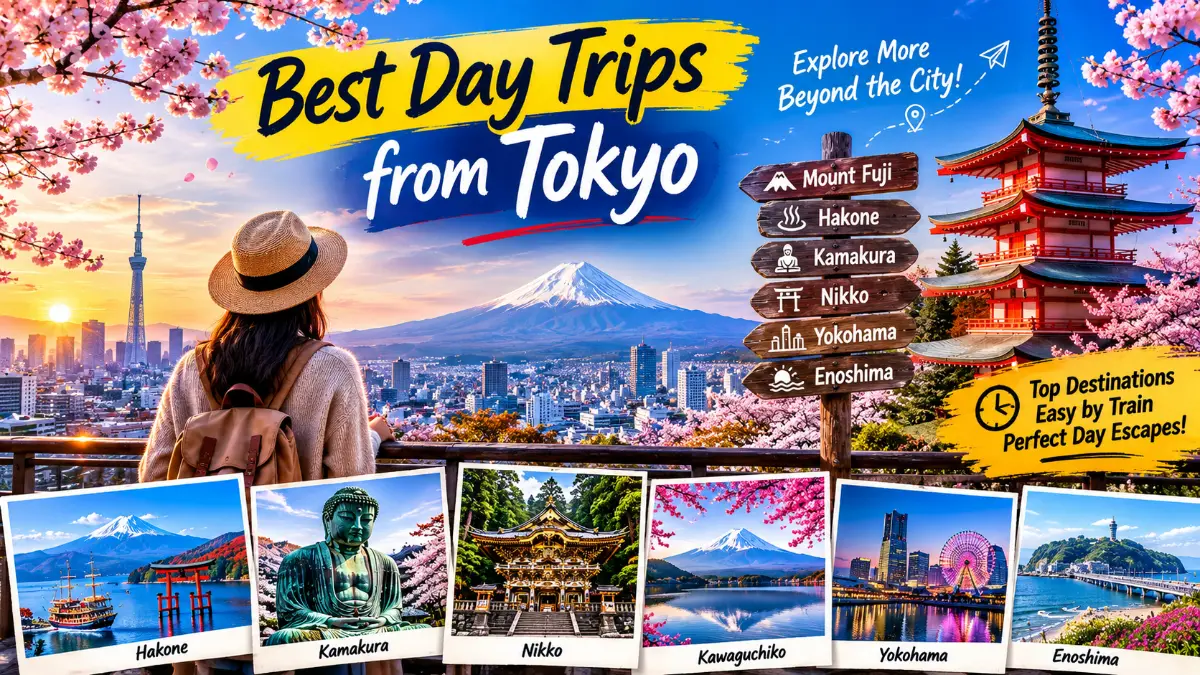
The best day trips from Tokyo are not simply the destinations with the most famous attractions. A great trip also depends on when you leave, how much transit the destination requires, whether crowds will slow you down, and whether the experience you want is actually suited to a single day. Kamakura, Hakone, Nikko, Kawaguchiko, and Yokohama can all work, but they require very different planning.
Instead of giving you another generic ranking, this guide focuses on the decisions that determine whether your day feels relaxed or rushed. Use it to choose the right destination, set a realistic time budget, avoid bad combinations, and decide when an overnight stay makes more sense.
Best Day Trips from Tokyo at a Glance
For most travelers, the first decision should be based on the experience they want and how much of the day they are willing to spend in transit.
| Destination | Typical One-Way Travel | Best For | Time to Allow |
| Kamakura | About 1 hour | Temples, history, coast | Half to full day |
| Hakone | Roughly 80–90 min to Hakone-Yumoto on direct limited express service | Onsen, volcanic scenery, museums | Full day |
| Kawaguchiko | Around 2 hours, depending on service | Mount Fuji views, lake scenery | Full day |
| Nikko | Around 2 hours on faster services | Historic shrines, forest scenery | Full day |
| Yokohama | Roughly 25–35 min from major Tokyo stations on suitable services | Chinatown, waterfront, easy escape | Half day |
These are planning estimates rather than promises. Railway schedules, service patterns, connections, weather, maintenance, and seasonal demand can change, so confirm your route before departure.
The Planning Rule That Prevents a Rushed Day
The most useful rule is simple: do not combine two destinations merely because both are described as Tokyo day trips. “Day trip from Tokyo” tells you that a place can reasonably be visited from the capital and returned from the same day. It does not mean two such destinations fit together.
Hakone lies southwest of central Tokyo. Kawaguchiko is west of Tokyo near Mount Fuji. Nikko is north of the capital. Moving between these regions can require indirect connections and substantially more time than their individual Tokyo travel times suggest.
Also Read: Osprey Farpoint 40 vs Other Travel Backpacks: Complete Comparison Guide
Before committing to a combination, check four things:
- Your actual departure station in Tokyo
- Door-to-door travel time rather than train time alone
- Local transportation after arrival
- The time required for the destination’s main attractions
For Hakone, Nikko, and Kawaguchiko, dedicating the day to one destination is usually the more satisfying approach.
Kamakura: Easy Access, but Timing Matters
Kamakura deserves its reputation as one of the most convenient cultural escapes from Tokyo. Direct JR services make it straightforward to reach from central Tokyo, while the relatively compact sightseeing area gives visitors access to temples, shrines, shopping streets, and the coast.
Kotoku-in is home to Kamakura’s famous Great Buddha, while nearby Hase-dera combines temple grounds with elevated views toward the sea. Tsurugaoka Hachimangu offers another major historic stop closer to central Kamakura. The important planning detail is that easy access also makes Kamakura extremely popular.
How to Make Kamakura Work Better
Arriving earlier in the day gives you more room to explore before the busiest period. Weekdays can also be preferable when your Tokyo schedule is flexible, particularly during popular seasonal travel periods. Rather than trying to check off every temple, choose two or three priorities. Kamakura becomes much more enjoyable when you leave time for the streets, food stops, and coastline instead of treating the town as a race between landmarks.
Should You Add Enoshima?
Kamakura and Enoshima are one of the more logical combinations in this guide because the Enoden railway links the coastal area. Enoshima adds a different character: island walks, shrines, sea views, and a more explicitly coastal atmosphere. However, it is still a destination rather than a quick photo stop. If Kamakura’s temples are your main priority, spend most of the day there. If you want an equal mix of culture and coast, start early and divide the day between Kamakura and Enoshima.
Hakone vs. Kawaguchiko: Choose Based on Your Real Goal
Hakone and Kawaguchiko frequently appear in searches for a Mount Fuji day trip from Tokyo, but choosing between them becomes easier once you stop treating them as equivalent Fuji viewpoints. Hakone is a varied resort region. Kawaguchiko is a stronger choice when Mount Fuji itself is the central objective. Trying to cover both properly in a single day usually sacrifices the strengths of each.
Choose Hakone for Variety
A Hakone day trip from Tokyo can include mountain transport, volcanic landscapes, Lake Ashi, museums, hot springs, and possible Mount Fuji views when conditions cooperate. Travelers commonly enter through Hakone-Yumoto and use combinations of the Hakone Tozan Railway, cable car, ropeway, buses, and sightseeing cruise.
Owakudani is known for its volcanic landscape and geothermal activity. The Hakone Open-Air Museum provides a completely different experience, combining sculpture and art with the surrounding mountain setting. The mistake is assuming the transport loop itself is fast. Transfers, queues, sightseeing stops, meals, and weather all consume time. A full-day mindset works much better than trying to squeeze Hakone around another destination.
Choose Kawaguchiko for Fuji-Focused Scenery
Kawaguchiko, in the Fuji Five Lakes area, is the stronger choice when your main goal is seeing and photographing Mount Fuji. Lake Kawaguchi provides multiple perspectives of the mountain. Another famous viewpoint is the Chureito Pagoda area at Arakura Fuji Sengen Shrine, where the pagoda, surrounding landscape, and Fuji can align in the classic composition seen in many Japan photographs. However, the experience has one variable no itinerary can control: visibility. Clouds can obscure Mount Fuji completely. A perfectly organized journey cannot guarantee the mountain will appear.
Why Hakone and Kawaguchiko Should Usually Be Separate Trips
There are transport connections between the broader Hakone and Fuji Five Lakes areas, so saying the destinations are impossible to combine would be inaccurate. The problem is efficiency. Travel between them can involve buses, transfers, traffic, and schedules that reduce sightseeing time. A traveler interested in Hakone’s loop and Kawaguchiko’s Fuji viewpoints will normally gain more by assigning them separate days.
Mount Fuji Visibility: Plan Around Weather, Not Promises
Mount Fuji is not an attraction with opening hours. Whether you see it depends on atmospheric conditions. Winter is generally associated with clearer Fuji viewing conditions than the hazier warmer months, but even seasonal patterns do not guarantee visibility on a specific date.
If Fuji is one of the most important goals of your Japan trip, avoid making your entire plan depend on a single fixed viewing opportunity when your itinerary allows flexibility. A practical strategy is to identify several possible days for Kawaguchiko and make the final decision closer to the trip after checking current forecasts and transport availability. That approach cannot guarantee a view, but it avoids treating a weather-dependent experience as though it were fixed.
Nikko: Worth the Longer Journey When You Give It a Full Day
Nikko is one of the best day trips from Tokyo for travelers whose priorities are historic architecture, religious sites, and forest scenery. The Shrines and Temples of Nikko are recognized as a UNESCO World Heritage property. Toshogu is the best-known component and is associated with Tokugawa Ieyasu, founder of the Tokugawa shogunate. Its richly decorated architecture, carvings, and forest setting create an experience very different from Kamakura’s coastal temple environment.
Why an Early Start Matters
The journey to Nikko is substantially longer than the journey to Kamakura or Yokohama. Once you add transportation between the station and heritage area, meals, walking, and sightseeing, a late departure quickly reduces the useful part of the day. Travelers using Tobu services from Asakusa can compare available limited express options when planning. Exact services and schedules should be checked for the travel date.
Read More: Urbex Meaning: What Urban Exploration Really Is
Should You Add Lake Chuzenji and Kegon Falls?
Lake Chuzenji and Kegon Falls extend the trip beyond the central shrine-and-temple area. They can fit into an ambitious itinerary, but including them changes the pace significantly because additional local transportation is required. If Toshogu and the World Heritage area are your priority, spending the day around central Nikko can be more rewarding than rushing onward. If the lake and falls are equally important, leave early and build the itinerary around transport times from the start.
Yokohama: The Smart Choice When You Only Have Half a Day
Yokohama solves a different problem from Hakone or Nikko: what can you do when you want to leave Tokyo but do not want to devote most of the day to transit? Its proximity to Tokyo makes it one of the easiest day trips from Tokyo by train. Yokohama Chinatown and the Minato Mirai waterfront can form the core of a compact visit. Depending on your interests, the waterfront can be combined with parks, shopping, museums, or simply an evening walk with skyline views.
Half Day or Full Day?
Calling Yokohama only a half-day destination undersells the city-there is enough to occupy travelers with specific interests for considerably longer. But for a Tokyo-based visitor seeking a change of scenery, a half-day itinerary is especially efficient. That makes Yokohama useful on a day when you have an evening reservation or activity back in Tokyo.
When Crowds Should Change Your Plan
Crowds are not merely an inconvenience, they affect how much of a day-trip itinerary is realistically achievable. Kamakura can become particularly busy because popular sights are concentrated in a relatively small area. Hakone can develop queues around major transport points, especially when visitor demand is high. Nikko’s most famous heritage sites also attract substantial tourism.
Weekdays can help, but they do not guarantee quiet conditions. Public holidays, school breaks, cherry blossom periods, autumn foliage, special events, and good-weather days can all influence visitor numbers. A better strategy than trying to predict a perfectly empty day is to build slack into the itinerary. Do not schedule every hour.
When a Day Trip Should Become an Overnight Stay
Being able to return to Tokyo at night does not automatically make a day trip the best format. Hakone is the clearest example. Travelers primarily interested in daytime sightseeing can visit in one day, but an overnight stay opens the possibility of a slower pace and a ryokan or onsen experience without watching the clock for the return journey.
Nikko can also reward an overnight stay if you want both the heritage district and the Lake Chuzenji area without compressing them. The Izu Peninsula deserves even more caution. It covers a large region, so whether it works as a Tokyo day trip depends heavily on the specific town or attraction. Treating the entire peninsula as one interchangeable destination is not useful planning. Kamakura, Enoshima, Yokohama, and Kawagoe generally lend themselves more naturally to shorter outings.
How to Choose the Best Tokyo Day Trip for Your Priorities
There is no universal winner. Match the destination to the experience you value most.
| Your Priority | Strong Choice | Main Planning Issue |
| Temples + coast | Kamakura | Crowds |
| Hot springs + varied scenery | Hakone | Local transport takes time |
| Mount Fuji photography | Kawaguchiko | Weather-dependent visibility |
| Historic shrines + forest | Nikko | Long travel day |
| Quick urban escape | Yokohama | Easy to underestimate how much the city offers |
| Kamakura + island scenery | Enoshima | Allow enough time for both |
For a first Tokyo visit, Kamakura is particularly easy to integrate. Hakone offers greater variety, while Kawaguchiko is the more focused choice for travelers prioritizing Mount Fuji.
Read More: What Pripyat Looks Like Today: Inside the Abandoned City in 2026
Transport Passes: Compare Before You Buy
Rail and sightseeing passes can simplify travel, but a pass is useful only when its coverage matches your actual itinerary. Hakone has dedicated pass options covering combinations of transportation in the area. Tobu also offers passes designed for Nikko travel. Their terms, validity, covered services, and prices can change, so compare the current pass conditions with the individual journeys you actually intend to take. Do not assume a national Japan Rail Pass covers every route in this guide. Private railways such as Odakyu and Tobu operate important services to Hakone and Nikko, and some limited express services involve separate conditions or charges. The cheapest-looking pass is not automatically the best option, convenience and route coverage matter too.
A Better Way to Plan Two Tokyo Day Trips
If your Tokyo stay has room for two excursions, choose complementary destinations rather than trying to combine them in one day.
For example:
- Kamakura + Hakone on separate days: culture/coast plus mountains/onsen
- Kawaguchiko + Yokohama on separate days: Fuji scenery plus an easy urban escape
- Nikko + Kamakura on separate days: two historic experiences with very different settings
This approach also gives you flexibility. If your Kawaguchiko day has poor weather, you may be able to swap it with a less weather-dependent outing.
Frequently Asked Questions
What are the best day trips from Tokyo for first-time visitors?
Kamakura, Hakone, Nikko, Kawaguchiko, and Yokohama are strong options, but they suit different priorities. Kamakura is particularly straightforward for history and coastal scenery, while Hakone offers a more varied mountain experience.
What is the easiest day trip from Tokyo?
Yokohama is among the easiest because of its short journey from central Tokyo. Kamakura is another convenient choice when you want a more substantial change of atmosphere without a long trip.
Should I visit Hakone or Kawaguchiko for Mount Fuji?
Choose Kawaguchiko when Mount Fuji views and photography are the primary goal. Choose Hakone when you want a broader day involving volcanic scenery, Lake Ashi, museums, onsen, and the possibility of Fuji views.
Can I visit Hakone and Kawaguchiko on the same day?
Transport between the areas exists, but trying to sightsee properly in both during a Tokyo day trip usually produces a rushed itinerary. Separate days are generally more practical.
Is Nikko possible as a day trip from Tokyo?
Yes. Nikko is a well-established Tokyo day trip, but its longer travel time makes an early departure and focused itinerary especially valuable.
Is Kamakura better on a weekday?
A weekday can reduce some crowd pressure compared with busy weekends, although seasonal peaks, holidays, and events can still make the town busy.
When is Mount Fuji easiest to see from Kawaguchiko?
The cooler, drier part of the year generally offers better visibility than the hazier warmer months. However, weather varies from day to day and no season guarantees an unobstructed view.
Do limited express trains need reservations?
Reservation requirements depend on the service. Limited express products such as the Odakyu Romancecar and Tobu limited express services use reserved seating arrangements, so check the current ticket requirements for your chosen train before travel.
Is Hakone better as a day trip or overnight stay?
Both work. A day trip suits sightseeing-focused visitors, while staying overnight gives you more time and makes a ryokan or onsen experience easier to enjoy without rushing back to Tokyo.
How many day trips should I take during a Tokyo stay?
There is no fixed number. For a shorter first visit, one or two carefully chosen excursions can provide variety without taking too much time away from Tokyo. Longer stays make it easier to add destinations based on weather and interests.
