
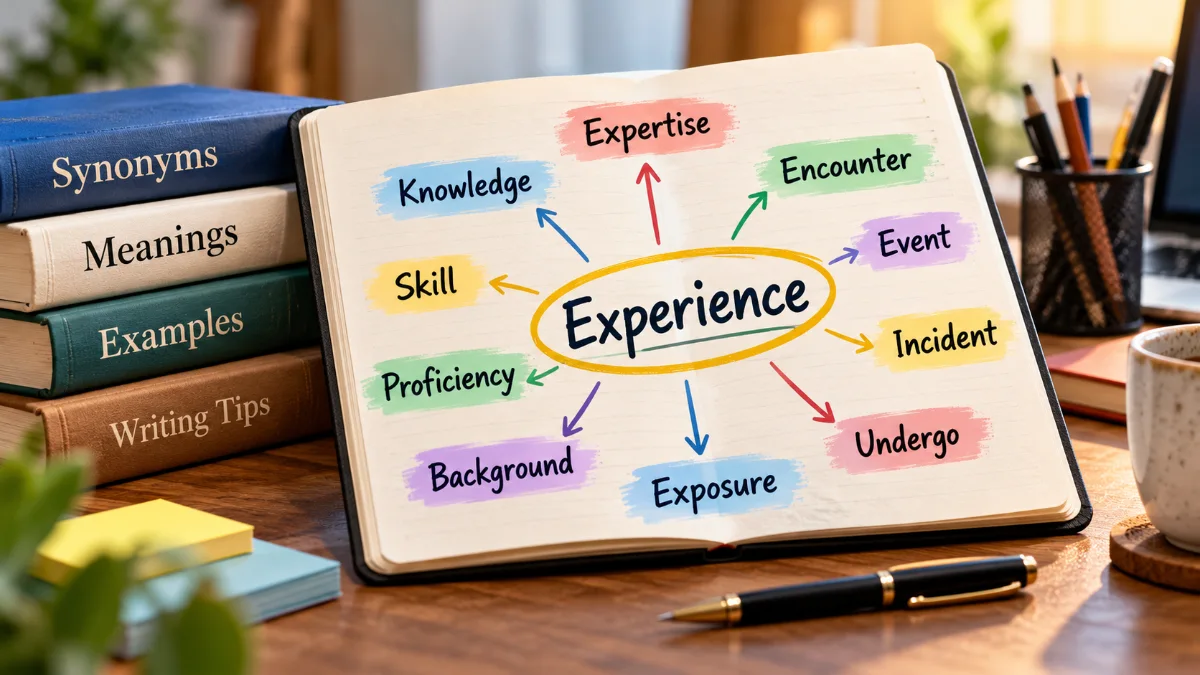
The best experience synonym depends on what you’re trying to say. Common alternatives include expertise, knowledge, skill, proficiency, background, exposure, encounter, and event. If you’re talking about professional abilities, expertise or proficiency may be appropriate. For something that happened to you, encounter or event might fit better. When experience is used as a verb, you can sometimes replace it with undergo, encounter, or go through.
Not all these words mean the same thing. The right choice depends on whether you’re describing skills gained through practice, a personal event, your professional background, or something you’ve lived through.
| Synonym | Best Used For | Example |
| Expertise | Specialized knowledge or ability | She has expertise in digital marketing. |
| Knowledge | Information and understanding | His knowledge of finance is extensive. |
| Skill | A developed ability | Communication is an important skill. |
| Proficiency | A high level of competence | She demonstrated proficiency in Spanish. |
| Background | Previous work, education, or training | He has a background in engineering. |
| Exposure | Contact with or familiarity with something | The internship provided exposure to healthcare. |
| Encounter | A meeting or particular experience | Their encounter was unexpected. |
| Event | Something that happens | The ceremony was a memorable event. |
| Incident | A particular occurrence | The incident happened during the meeting. |
| Undergo | To experience a process or change | The patient underwent treatment. |
Read more: Perpendicular Lines: From Right-Angle Recognition to Coordinate Proofs
Experience Synonyms by Meaning
The word experience can describe several different things. Sometimes it refers to knowledge you’ve gained by doing something. Other times, it means an event you’ve been through or something that happened to you.
As the definition of experience shows, the word functions as both a noun and a verb. That distinction matters when choosing a replacement. A synonym that sounds natural in one sentence may not work in another.
Understanding these meanings helps you find another word for experience without changing what you intend to communicate.
Synonyms for Knowledge and Skills
When experience refers to knowledge gained through education, practice, or work, these alternatives may be suitable:
- Expertise: Specialized knowledge or skill developed through learning and practice.
- Knowledge: Information and understanding gained through study or experience.
- Proficiency: A strong ability to perform a particular activity.
- Know-how: Practical knowledge of how to accomplish something.
- Background: Previous education, training, or experience related to a subject.
- Competence: The ability to perform a task effectively.
Consider this sentence:
“She has extensive experience in software development.”
You could write:
“She has extensive expertise in software development.”
Both sentences sound natural, but they don’t communicate the same thing. Experience emphasizes someone’s involvement in a field, while expertise suggests a high level of specialized knowledge or ability.
Use expertise when someone’s demonstrated skills justify it. A person can have years of experience without necessarily being an expert.
Synonyms for Personal Experiences and Events
When experience refers to something that happened, choose a synonym based on the situation.
Encounter usually describes meeting someone or coming into contact with something, often unexpectedly.
“The traveler described an unusual encounter with wildlife.”
Event refers to a particular happening or occasion.
“Graduation was an unforgettable event for the entire family.”
Incident describes a specific occurrence, frequently something unexpected or unpleasant.
“The manager documented the incident for future reference.”
Occurrence is a somewhat more formal word for something that happens.
“Such an occurrence is uncommon during the winter.”
These words can be useful in everyday conversation, storytelling, and academic writing. However, they aren’t universal replacements. A meaningful life experience, for example, may involve several events rather than one encounter.
The meaning of encounter also shifts slightly depending on whether you use it as a noun or a verb.
Synonyms for Experience as a Verb
When experience functions as a verb, it often means to feel something, encounter a situation, or undergo a particular event.
| Alternative | Example Sentence |
| Undergo | The building underwent major renovations. |
| Encounter | Travelers may encounter unexpected delays. |
| Go through | She went through a difficult transition. |
| Feel | He felt considerable relief after the examination. |
| Live through | They lived through a period of major change. |
The best replacement depends on what the sentence describes.
For example, “experience happiness” can become “feel happiness.” However, “experience surgery” is usually more naturally expressed as “undergo surgery.”
Similarly, live through often emphasizes enduring a difficult period or significant event rather than simply encountering something.
Professional Experience Synonyms for Resumes
Professional experience synonyms can help you describe your qualifications more precisely in resumes, cover letters, and business communications. The aim isn’t to make your abilities sound more impressive than they are. It’s to explain what you know, what you’ve done, and how confidently you can perform particular tasks.
| Original Phrase | Alternative |
| Experience in customer service | Customer service background |
| Experience managing projects | Project management expertise |
| Experience with accounting software | Proficiency in accounting software |
| Experience working with databases | Practical knowledge of databases |
| Experience in sales | Sales background |
| Experience with laboratory equipment | Hands-on laboratory experience |
These alternatives should reflect your actual qualifications. For instance, someone who occasionally assists with projects might have project management exposure, but claiming project management expertise could overstate their abilities.
The same applies to technical skills. Proficiency indicates a developed level of competence, not merely that you’ve used a tool once or twice.
Choosing the Right Wording for Your Resume
Use background when summarizing previous employment, education, or training. Choose proficiency when you can demonstrate a particular skill, such as working with software or speaking another language. Reserve expertise for areas where you have strong, specialized abilities.
Phrases such as hands-on experience and practical knowledge are especially useful when direct involvement matters. They help distinguish work you’ve actually performed from something you’ve only studied.
You don’t always need to replace experience, either. “Five years of experience in customer service” is perfectly clear and professional, provided the statement is accurate.
Experience vs. Expertise, Knowledge, and Exposure
Although these words are closely related, they describe different levels or types of familiarity.
| Word | Main Meaning | Important Difference |
| Experience | Knowledge or familiarity gained through participation | Emphasizes involvement or practice |
| Expertise | Specialized knowledge or advanced ability | Emphasizes depth of competence |
| Knowledge | Understanding or awareness of a subject | Does not necessarily require practical involvement |
| Exposure | Contact with or introduction to something | Does not necessarily indicate developed skills |
Think about someone learning graphic design.
A student who reads books about graphic design gains knowledge. Someone who watches professional designers at work gains exposure to the field.
A person who regularly creates designs develops experience, while a designer with strong, specialized abilities may eventually develop expertise.
The distinction is important because exposure means someone has encountered or become familiar with something; it doesn’t automatically demonstrate competence.
Choosing the most accurate term helps you communicate clearly, particularly in job applications, academic assignments, and professional discussions.
Experience Synonyms With Example Sentences
The following experience synonyms with examples show how changing a word can improve a sentence while keeping its intended meaning.
1. Professional knowledge
Original: “He has experience in financial planning.”
Alternative: “He has expertise in financial planning.”
The alternative emphasizes specialized competence. It’s appropriate when his actual abilities support that description.
2. Previous employment
Original: “She has experience in the healthcare industry.”
Alternative: “She has a background in the healthcare industry.”
Here, background emphasizes previous employment, education, or involvement in the field.
3. Personal event
Original: “The trip was an unforgettable experience.”
Alternative: “The trip was an unforgettable adventure.”
Adventure is a good choice if the trip involved excitement, exploration, or unusual activities. It wouldn’t necessarily fit an ordinary business trip.
4. Unexpected situation
Original: “We experienced several technical problems.”
Alternative: “We encountered several technical problems.”
Encountered works naturally here because the sentence describes difficulties that arose.
5. Practical ability
Original: “He has experience using spreadsheet software.”
Alternative: “He is proficient in spreadsheet software.”
The second version suggests a stronger level of ability. Use it only if he can perform tasks competently with the software.
6. Emotional experience
Original: “She experienced a sense of relief.”
Alternative: “She felt relieved.”
The shorter sentence sounds more conversational without changing the meaning. When describing feelings, feel is often a simpler choice than experience.
Frequently Asked Questions
Is “experience” countable or uncountable?
Experience can be either, depending on its meaning. When it describes accumulated knowledge or skills, it’s generally uncountable. For example, “She has extensive teaching experience” is correct.
When referring to individual events, it becomes countable. You might say, “Traveling abroad gave him several memorable experiences.” In that sense, you can use the plural experiences or the singular with an article, as in “It was an unforgettable experience.”
Is “experiences” the same as “experience”?
Not exactly. Experience can refer to accumulated knowledge, a general situation, or one particular event. Experiences is the plural form and usually describes separate events or things someone has lived through.
For instance, “She has management experience” refers to her professional familiarity with management. “She shared her travel experiences” means she talked about particular things that happened during her travels.
